
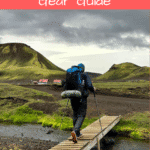
In this guide to backpacking gear for the Laugavegur trail, I'll share what worked well for us on this multi-day Icelandic trek!

Are you planning on backpacking Iceland's Laugavegur Trail? We did, and camping the Laugavegur Trail was one of the most memorable experiences of our lives.
While we are not beginner backpackers, this was our very first time planning a route in Iceland. Because of the notoriously harsh and unpredictable climate, we gave careful thought to what backpacking gear we'd take on the Laugavegur trail.
We prioritized rain protection and warm layers in case we ended up backpacking in the rain.
When we packed up our backpacking gear and flew to Iceland, I was nervous to see how our gear would perform. For the most part, I was happy with our choices, but if we went again, I'd definitely change a few items.
With this hike now in hindsight, I'll share with you what we used, what worked well, and what we wouldn’t take again.
Backpacking Gear We Loved for the Laugavegur Trail
Basic Gear
- Trekking poles
First of all, I highly recommend bringing two trekking poles on this trail. They’re extremely helpful, not just on the trail, but also with the water crossings.
We both carried Black Diamond Alpine Trekking poles, which we've used for years. These poles have been reliable and keep on... err... trekking.

- (His) backpack and a waterproof liner
My husband carried a Zpacks Arc Haul 60L pack with a waterproof liner inside. It stayed dry and performed very well. The main thing I liked about his pack (over mine) was that it was easy to use a pack liner instead of a rain cover.
A couple years after this trip, I started using a Durston Kakwa with a waterproof liner inside, and would recommend that pack for the Laugavegur as well.

- MSR groundhog tent stakes
We used a combination of the mini groundhog stakes and standard longer groundhog stakes, and they did well, though we did often reinforce the stakes by topping them with rocks.
- An extra-warm sleep setup
For bedding, we used an Exped sleeping pad, an Enlightened Equipment down quilt, Sea to Summit sleeping bag liners, and my new spoiled double pillow setup — a Nemo Fillo Elite paired with a Hyperlite Mountain Gear pillow (stuffed with clothes).
- A satellite messenger device
The trail was wild enough that I was grateful to have my Garmin inReach mini as a way to send messages any time I wanted (and to have an SOS option). I rarely needed to check the map on it, though.
Cook System Gear for the Laugavegur Trail
We were quite happy with our cook system and would likely use the same again. For more tips on what food to bring, check out our post on food for the Laugavegur Trail.
- Our backpacking stove was our MSR PocketRocket, paired with our Toaks titanium cookpot. We opted for our larger Toaks pot over our smaller Evolved cookpot so that it would be easier to make soups.
- We also brought along long-handled sporks and a titanium cup.

Gear for Rain Protection
This jacket was breathable and held up like a champ to consistent wet conditions. I'd highly recommend it.
I was less happy with the rain jacket I brought, but later I tried out the Montbell Super Dry Tech rain jacket and found it to be just as wonderful as the Versalite.
He wore these, and they're perfect if you carry weight in the waist or are not curvy. They're less ideal if you’re hourglass-shaped or carry weight in the thighs.
This worked perfectly as a rain pants alternative and an easier fit for curvy people.
If you’re average height or tall, I’d probably recommend the slightly longer Enlightened Equipment rain skirt for more coverage. (At 5-foot-2-inches, I did better with the shorter Montbell one.)
I also used this skirt for extra wind protection and wore it when the water crossings were deep enough that I thought my pants would get soaked despite rolling the legs up.
- Rain protection redundancies
We packed some items in waterproof bags. Our food went in a Hyperlite Mountain Gear roll-top dry bag, clothing in these Hyperlite’s pillow stuff sacks, and our sleeping pad and down quilt in a variety of other waterproof bags that we had on hand.
Clothes for Backpacking the Laugavegur Trail
I underestimated how cold this trail would be.
The temperature was regularly in the low or mid 40s (Fahrenheit), one day was in the high 30s, and it only occasionally and briefly went into the low 50s. With the wind chill, it dropped below freezing the first day and evening.
Of course, weather is unpredictable. I’ve heard that there were warmer days in the weeks leading up to our late July hike. Even so, I was mostly happy with the clothing we brought.
Here’s what we wore:
Basic Clothing
- Sunglasses. The sun rarely came out the entire time, but I occasionally wore them to protect my eyes from strong wind. (It can get sunny, though; it just didn’t for us.)
- Arms of Andes alpaca shirts, both long sleeve and short sleeve.
- Kuhl Klash pants. I was thrilled with the Kuhl Klash pants. The thicker abrasion-resistant fabric was perfect for the weather, and I loved that all the pockets zip closed. My husband was also very pleased with his hiking pants.

- For pajamas, we both brought an alpaca wool hoodie and Icebreaker leggings. We also brought balaclavas for keeping our noses warm at night.
- I’d also recommend bringing an eye mask, or at the very least a neck gaiter that can double as an eye mask. Otherwise, the sun will likely wake you up at 2 or 3 a.m.
Footwear
- For footwear, we both wore non-waterproof trail runners (Altra Lone Peaks) and trail gaiters. This trail has lots of small, loose rocks, so I’m glad we brought gaiters, especially since we opted for shoes instead of boots.
- Hollow alpaca ankle socks. I can’t recommend these socks highly enough! They kept our feet warm and dry the whole time. That’s quite the accomplishment on this trail!
- Neoprene socks for water crossings. These were amazing and I highly recommend. They made the icy water much less painful. My husband also wore Xero sandals over his socks for water crossings. I just used the socks.
Outerwear
- Montbell Superior Down Jacket (mine with a hood, his without). He was thrilled with his; I wished I’d opted to bring this warmer Katabatic jacket. Here are more thoughts on backpacking with ultralight down jackets.

- Gloves. We brought neoprene gloves and rain mittens, and wore them together on cold rainy days. The neoprene did a good job of staying warm even when wet.
However, I found that sometimes my hands got way too cold, and I wished I’d brought a backup of warmer gloves or mittens. (My husband’s hands were fine with just the neoprene gloves and rain mittens.)

Gear We'd Recommend (With Reservations)
Some of the backpacking gear we brought for the Laugavegur trail performed (mostly) fine, but I felt it was tested to its limits. Here's gear I'd consider bringing again, but with reservations.
- A 3-season tent
We opted for an ultralight 3-season tent; however, if we did this trail again we’d bring a 4-season tent. The winds on this trail are wild and have potential to be even stronger, so I’d feel more comfortable with a 4-season tent, despite it being “summer.”
We used the TarpTent Double Rainbow DW on this trail, and we saw others using another favorite 3-season tent, the Durston X-Mid 2. Read this post for our comparison of the two tents.
We opted for the Double Rainbow over the X-Mid because it has a free standing option and we were unsure if the ground would sometimes be too rocky to easily stake a tent. (It wasn’t, for the record.)
Our tent did fine, although it did struggle a little in high wind. We had to patch a tear from setting it up during a windstorm.

Gear We Wish We'd Brought
There were a few items we didn't pack that we missed. Here's what we'd add to our backpacking gear for the Laugavegur Trail if we did it again.
- Extra guy-lines
In hindsight, we should’ve brought more than two guy-lines, but we underestimated how strong the winds would be (even when not under a yellow wind warning). The two guy-lines held, but if we did this trail again (or any camping route in Iceland), we’d bring extras.
- Soap for showers
There was hand soap and dish soap provided at hut restrooms, but we wished we'd brought something for showers.
- A garbage bag (maybe)
This trail is typically accessed by an off-road capable bus. I read that if the rivers on route to the trailhead get high, water can sometimes get under the bus in the luggage storage.
Some hikers place their entire pack inside a garbage bag before stowing it under the bus. When we hiked, the rivers weren’t high and the bus driver assured me the luggage area was staying dry. (I skipped the garbage bag and was fine, but on a year where the rivers are higher, I'd take one.)

Gear We Wouldn't Bring Again
- (My) backpack and rain cover
The pack I carried (an Osprey Eja Pro) was less cylindrical than my husband's pack and not at ALL waterproof or resistant, so I had to opt for a rain cover instead of a pack liner.
While it worked to keep my gear dry, the rain cover was incredibly noisy from constantly flapping in the wind and annoyed me. At times it flapped so hard that it even made me feel a bit off-balance.
If you opt to use a pack and rain cover, be aware it will probably be noisy. Also, make sure to get a pack cover that snaps around your bag, otherwise it will almost definitely fly away.

- My Black Diamond Stormline rain jacket
I made the poor decision of packing a rain jacket that just wasn't rated for the type of consistent, drenching weather we'd be hiking in. After this trip, I did a deep dive on rain jackets and what the different waterproofing levels mean.

Gear We Never Used (And If I’d Bring it Again)
- Bug nets. I’ve been told there are non-biting midges along this trail at times, but we never had any issues with bugs. I’d probably still bring bug nets if we hiked again, because they’re small and weigh almost nothing.
- Headlamps. Despite it being daylight almost 24/7 when we were there, I read these would be good to use for the hut restrooms, but I never needed them. (Then again, I never got up to use the restroom between 12:30 a.m. and 3 a.m.)
If you’re continuing onto the Fimmvörðuháls Trail, the dry toilet at the Baldvinsskali Hut was darker, but I still didn’t use the headlamp. I’d likely skip these if we did the trail again.
- Micro-spikes. I never needed these on the Laugavegur when we hiked it, but we did use them on the Fimmvörðuháls Trail. I would probably carry these again anyway for the Laugavegur in case we came on a warmer year where the snow was melting and refreezing more.
- Sawyer Squeeze water filter. Each hut had tap water available, so we never needed to collect water from streams. Even the Baldvinsskáli hut on the Fimmvörðuháls Trail had tap water (as of July 2024). I’d likely bring this filter anyway if I hiked it again, as it’s fairly lightweight and could be invaluable in an emergency.
- Helinox Camp chairs. We actually did use these once, but because most of the campgrounds had a camper shelter with benches, we didn’t use them enough to make me feel like they were worth carrying. Instead I’d consider bringing a sit pad (or nothing).
I hope our experience with backpacking gear on the Laugavegur trail helps you decide what to bring and what to skip! Do you have any other ideas or recommendations? Let us know in the comments!


Joshua Clarke says
Hi there! Really great trip post. My wife and I are pretty much doing the exact same trip in July. I’m curious where you stayed at the end of the FIMMVÖRÐUHALS TRAIL? Or did you bus right back? We’re wondering if we can camp next to the Skógafoss Waterfall or should we try find alternative accommodation in the Skógar area? We don’t take the bus back to Reykjavik until the following day. Any recommendations would be greatly appreciated. Thanks!
Josh
Sarah Trenalone says
Hi Josh! For the Fimmvörðuháls Trail, we camped about halfway at the Baldvinsskali Hut, and then the next day hiked down and took the city bus 51 back to Reykjavik in the afternoon.
This post has more info on that: https://champagne-tastes.com/hiking-the-fimmvorduhals-trail/
Happy hiking!!